Bible
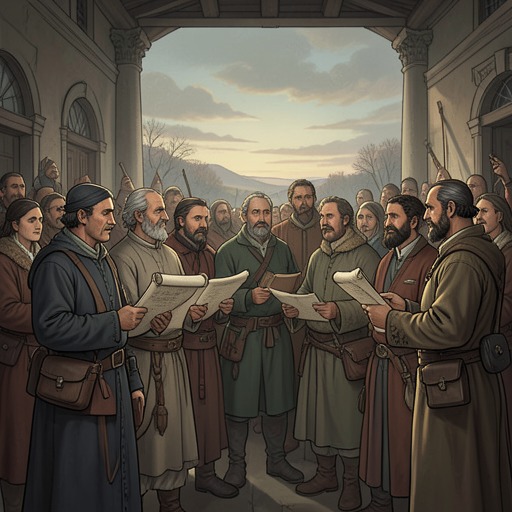
Book of EstherThe Bible occupies two connected roles in the author’s argument: it is the testimony by which Christian claims are known, and a text whose preservation and eventual availability to ordinary readers are themselves interpreted as acts of providence. Its history runs through threatened manuscripts, scarce writing materials, printing, and expanding literacy; its contents, especially the account in Esther, are offered as evidence that human responsibility and God’s overruling purpose can coexist.
Scripture as Testimony
The author distinguishes the Bible’s evidential role from a comprehensive defence of Christianity. Although he acknowledges that the many proofs of Christianity could fill volumes, he concentrates on what he regards as the Bible’s own testimony: the character of God revealed in its account of salvation. The Bible, he argues, is open to inspection and understandable even to readers of limited learning. Its claim does not depend solely on external testimony; the account of God it presents is itself evidence of divine origin.
That argument culminates in the claim that the Bible reveals a harmony among God’s attributes unavailable through philosophy or observation of the created world alone. The atonement makes justice, mercy, love, sovereignty, and holiness visible together. In the author’s view, the gospel is therefore not merely a message carried by the Bible: its presentation of God is a distinctive reason to believe the message true. The Bible’s account of salvation supplies the setting in which those attributes can be seen in their full relation.
Preservation Through Hostile Custody
The author treats the Bible’s transmission through the Church of Rome as a striking instance of providence, but does not credit that institution with being the only means by which the text survived. He argues that Eastern churches and groups separated from the Western church could have preserved it even if every copy held by the Church of Rome had been destroyed. His narrower point is that the Bible remained in the hands of an institution whose interests, in his view, called for its suppression or corruption.
This unlikely custody becomes an argument from reversal: the institution described as hostile to the Bible nevertheless handed it down, and the text it preserved was destined, in the author’s account, to expose and overcome that institution. He compares the Bible’s survival under this pressure to a prisoner kept alive among lions. The comparison makes preservation more than passive endurance; it becomes a providential contrast between the custodian’s presumed aims and the eventual use of the text. The author also emphasizes that the Church of Rome sought to keep the Bible from ordinary people, even while the volume passed through its custody.
Paper and the Cost of Books
Material conditions form a major part of the Bible’s history in the book. The author dates the invention of papermaking to the eleventh century and connects it to the disruption of European access to Egyptian papyrus after the Saracen conquest of Egypt in the seventh century. As papyrus became unavailable, books were written on parchment, which was so costly that old writing was sometimes erased to make the material usable again. In the author’s account, the resulting scarcity put books beyond the reach of most private readers.
The details make that scarcity concrete. A monastery of considerable standing might possess only one missal; in 855, Lupus, archbishop of Ferriers, asked the pope to lend him complete copies of works by Cicero and Quintilian because France lacked a complete copy. The Countess of Anjou reportedly paid two hundred sheep, along with quantities of wheat, rye, and millet, for a copy of homilies. The author reasons that if writing materials had remained so expensive, the Bible could not have become a book for households across society. He also notes the importance of the timing: he associates the eleventh-century invention with the revival of learning that later contributed to the Reformation.
Printing, Literacy, and Circulation
Paper alone could not make the Bible widely available while books had to be copied by hand. The author therefore treats printing as the necessary completion of papermaking’s promise. He places the invention of printing in Germany or Flanders around 1420, first using wooden blocks bearing the characters of whole pages, and the development of movable type about thirty years later. He says that printing was brought to a high degree of perfection in France within a century of its invention by Robert Stephen and his son Henry. The result, in his argument, was a sharp change in the scale of access: a book that had once cost as much as building an ordinary country church could be multiplied until each family might possess a Bible. Stereotype printing, which he describes as a recent further improvement, reduced the expense again.
The history of reading completes this account of access. The author cites descriptions of the Dark Ages in which even people of high rank could not read or write and some clergy struggled to read the breviary they used. He contrasts that general illiteracy with the later growth of education, including the efforts of Sunday schools and religious societies. A small English edition of six hundred Bibles during the reign of Henry VIII reportedly took three years to sell. In the author’s interpretation, the gradual spread of reading made it possible for more people to encounter the Bible directly, while even educational efforts undertaken for other purposes could contribute to that result.
Writing and print also enabled communication about the Bible’s meaning across great distances. A Christian could teach, correct, or encourage others without the inconvenience of traveling to them; interpretations could circulate, errors could be challenged, and religious zeal could pass among separated communities. The author recognizes that the same facilities spread error. He nevertheless regards debate and correction as capable of deepening believers’ understanding, while insisting that the Bible’s usefulness is not cancelled by its misuse.
Providence in the Text and Its History
The Bible’s narrative of Esther provides the author with a model for understanding how providence operates without absolving human agents. He reads the command that brought Vashti into conflict with the king, Esther’s elevation, and the conduct of Mordecai as events through which the Jews’ eventual deliverance was prepared. He is sharply critical of the human actions involved: he considers the marriage of Esther, also called Hadassah, to a heathen king a violation of Jewish law, and argues that Mordecai could have shown Haman the civil respect the king required. Yet he insists that the wrongdoing and ignorance of the participants remained theirs even as their actions served a purpose they did not intend.
That reading shapes the book’s broader claim about the Bible. Human beings act from their own purposes and remain answerable for their choices, while God can incorporate their actions into an outcome beyond their knowledge. The same structure, the author suggests, appears in the Bible’s material history: inventions, institutional actions, and educational changes can have consequences their human agents did not foresee. The movement from costly manuscripts to printed copies is thus both a history of changing access and, for the author, evidence that providence directed those changes toward the wider circulation of the text. In this account, the Bible is at once the record through which providence is interpreted and the book whose survival and dissemination are presented as part of that history.